The business climate in Abu Dhabi has its own particular pressures around ISO certification, shaped heavily due to the city's concentration of government organizations, major industrial corporations, and stringent Tendering requirements. For local companies attempting to obtain Certification for the first-time, understanding the practical realities specific to Abu Dhabi makes the process significantly more daunting.Government and Semi-Government Tenders Set the Pace
The bulk of Dubai's economy relies on big industrial players. Many of which have formalised ISO certification as an eligibility requirement for contractors and suppliers. The choice to seek certification is usually driven less by internal ambition, but more by the reality of contracts a company would like and will be able to get.
Industries and Energy Sectors Have Particular expectations
The energy and the industrial sectors are characterized by extremely stringent expectations regarding environmental and safety management due to the size and risk-based nature of operations within these fields. Businesses supplying into this ecosystem and indirectly, frequently observe that the certification requirements of their direct customers are much greater than the base required standards, reflecting the company's internal environment of management for risks.
Choosing a Standard That Matches Your Actual Operation
The most frequent mistake made is seeking certification because another company has it without first mapping which standard really matches the company's exposure profile and client expectations. Logistics firms' priorities are completely different from a facility management company, and starting with a clear-eyed assessment of what clients and tenders actually need will help avoid a lot of energy later on.
This Gap Assessment Stage is a Worth Taking Seriously
Before formal implementation begins conducting a gap assessment using the appropriate standard shows how well existing practice has a good relationship with the standards and areas where genuine work is needed. A rush or lack of time at this point leads to a longer cost and costly implementation later on because the gaps that could have been identified early but are discovered later during the audit the audit itself.
Documentation Requirements Are Much More Manageable than They Make It Sound
Many first-time applicants feel that ISO requirements for documentation will be overwhelming, but modern management system specifications are less restrictive about documentation than older versions were, focus is on proving that processes are actually adhered to rather than merely documenting. An approach that is practical to document founded on what a business is likely to want to track in the first place, is likely to create systems that are actually used rather than one that exists purely for audit purposes.
Local Support Options have gotten bigger Definitively
Abu Dhabi now has a significantly larger pool of certification bodies and consultants with local sector expertise that it had just five years ago, which has reduced dependence on international companies with no on-the-ground knowledge of the local context. This increased local presence has made the process quicker as well as more adaptable to specific requirements of operating within the Emirates.
Maintaining Certification requires ongoing commitment
It's not a singular achievement but an ongoing commitment that includes regular surveillance audits, typically every year, to verify that the management system remains properly maintained. Companies that consider the initial certificate as a way to finish rather than the initial point of entry tend to struggle in subsequent audits. However, those who incorporate the requirements of the standard into their daily routines find recertification considerably more straightforward.
Businesses in Free Zones Face Particular Considerations
The companies that operate in Abu Dhabi's various free zones might assume that certification requirements are different from those for companies in the mainland, but the underlying international standards themselves remain the same regardless of country. What does differ is the specifics of tenders and expectations for clients in each tenant community, which is necessary to address directly with free zone authorities or prospective clients, rather than taking an all-encompassing answer that applies to all.
Realistic Budgeting for the Full Process
First-time applicants typically budget to cover the cost of external audit but neglect to include the internal time investment as well as the possibility of consultant costs, and any operational adjustments that are needed to close those gaps in the assessments. An effective budget accounts for the full journey from initial assessment to certificate issue, not just paying the final audit invoice in order to avoid being surprised at the end of the project.
Timing Certification around Business Cycles
Businesses that have clear seasonal peaks that are common in the construction and related industries, usually prefer to schedule the more rigorous testing and implementation phases in slower times rather than trying to coordinate an accreditation project at the same time as peak operational demands. Abu Dhabi's certification bodies are generally flexible with the timing of their projects, and increasing preferences early in the process is likely to facilitate a more smooth experience for everyone affected.
Learning From Businesses That Have been through it before
Speaking directly with other Abu Dhabi businesses in a similar sector that have received certification typically provides real-world insights that no consultant or certification body will volunteer unprompted, for example, realistic timelines or aspects of the audit tend to catch prospective applicants off in the dark. This type of information from peers is extremely valuable and worth making sure to look for before signing to a particular company or timeline.
Working With Government Liaison Requirements
Businesses that seek certification specifically to be eligible for government tenders which are held in Abu Dhabi should confirm exactly the scope of certification and version the tender is requesting as requirements may refer to specific editions, or even additional local requirements that go beyond the base international standard. Verifying this information directly with the tendering authority prior commencing the certification process helps avoid the possibility of getting certification against a scope that is not the correct one.
For Abu Dhabi businesses approaching certification for the first time, the success usually depends on selecting the right standard for actual operational reality, while taking the process seriously, and consider certification as an ongoing management discipline, not being a tick-box to mark once and forget about. Abu Dhabi businesses that approach certification with the same level of preparation rather than using it as a last-minute tender requirement to be rushed through, usually end up with a stronger, more genuinely useful management system at the end. The whole process isn't required to be taken on by oneself, since Abu Dhabi's increasing number of local experts and certification bodies that offer genuine assistance is more readily available than at any previous point. The growing local expert base makes the entire process considerably more manageable than it once was. Follow the most popular ISO Certification Services for more tips.
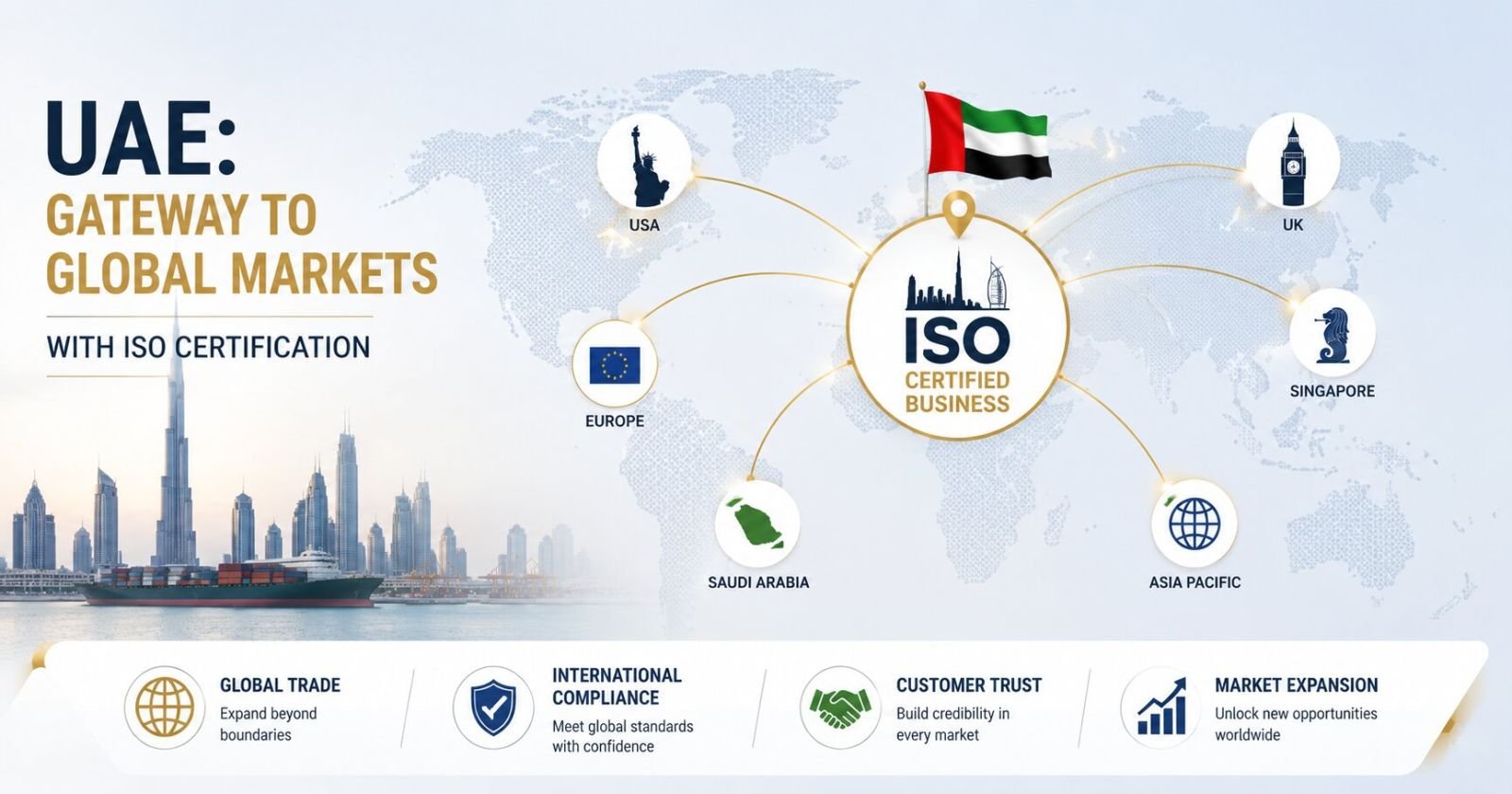
ISO 9001 Explained: Quality Management for UAE Businesses
ISO 9001 remains the most widely recognised management system standard worldwide, and for good reason. It's based on the practical concept, that is that quality comes from consistent, properly managed processes rather than intentions on their own. For UAE companies who are thinking of obtaining certification, knowing what the standard actually needs can help clarify a process that often sounds more complex than it actually is.What ISO 9001 Is Actually Based On
The premise behind ISO 9001 is that ISO 9001 asks a business to establish its most important processes in order to comprehend how they interact, monitor whether they're actually functioning, and then improve them systematically over time. Instead of setting out the specific ways an enterprise should conduct its business the framework provides to ensure that any strategy that a business follows will be consistent and documented when it is necessary, and strictly adhered to.
What is the reason UAE Businesses Are Interested in It?
Beyond its reputational benefit of the ISO 9001 certification, numerous UAE businesses pursue ISO 9001 because government and private sector tenders often list it as an essential requirement to be prequalified. Beyond ticking that box companies that use it properly often find genuine positive operational results, such as less unintentional mistakes, a more clear accountability and a more disciplined approach to dealing with customer complaints.
The Role of Top Management
A key area where the standard is especially firm on is the genuine leadership involvement, rather than quality management being delegated entirely to only one compliance officer that is detached from actual decisions. Auditors specifically look for evidence that the top management understands and actively support the quality management system, instead of merely signing on it.
The importance of Risk-Based Thinking is a central part of the Modern Standard
The current version of ISO 9001 places considerable emphasis in identifying opportunities and risks relevant to an organization's specific setting, rather than using the same checklist in all circumstances. This means that a UAE construction firm and an UAE software company, even though both certifying against the same standard in the end, will have significantly different quality management processes that reflect their distinct risk profile.
Customer Focus Runs Throughout the Standard
ISO 9001 repeatedly returns to the notion that quality means meeting customer requirements along with expectations. Quality isn't merely internal efficiency measures. Businesses that comply with the standard are expected to have genuine mechanisms to understand what their customers need and measuring whether they're happy, rather than believing that internal quality controls alone provide the whole picture.
This Certification Process Itself
Following the introduction of the processes and documents, certification involves an audit by an outside party that takes two stages. The first is reviewing documentation and readiness, before looking at whether the system truly operating as stated. This is followed by yearly surveillance audits, and finally a complete annual recertification audit about every three years, to check continuous conformity.
Common Misconceptions That Need To Be Dispelled
One of the most frequent misconceptions is that ISO 9001 requires enormous volumes of paperwork. The current version actually reduced mandatory documentation significantly compared to earlier versions. It is more focused on the demonstration of a genuine process control. Another myth is that certification guarantees the quality of products directly, but actually, it is a proof that businesses have a consistent approach to managing quality that is a different but still important.
The different ways it applies across Sectors
Construction companies that have adopted ISO 9001 will focus heavily on project handover processes and subcontractor management. While a professional services company might concentrate more on customer engagement processes and management of knowledge. Its true flexibility across sectors is part of why it's relevant across the broad range of UAE industries starting from manufacturing and moving to consulting and retail.
The Importance of Continuous Improvement
ISO 9001 doesn't treat quality as a permanent goal instead it's an ongoing process of evaluating effectiveness, identifying potential areas to improve, then implementing those changes gradually. Companies that embrace this continual improvement mindset, rather than viewing certification as a once-in-a-lifetime endeavor, tend to see the greatest operational advantages from the standard.
Preparing Your Team to handle the Cultural Shift
Perhaps the most overlooked aspect during ISO 9001 implementation is the essential shift in culture, switching from informal, individual-dependent methods of working towards more consistent, structured processes that aren't dependent on one person's memory or judgment. The preparation of staff members for this shift and communicating the advantages rather than treating it purely as a compliance exercise makes a huge difference in how smoothly Implementation goes.
Why the Investment Tends to Pay Off
Businesses that implement ISO 9001 thoughtfully, rather than simply the exercise of completing paperwork to meet an external requirement, generally observe that the investment pays off through less frequent errors, greater internal accountability and a much stronger foundation for scaling operations as the business grows, benefits that transcend the requirements of the certificate its own.
The way ISO 9001 Interacts With Customer Representations Specifically
The standards require businesses to implement a legitimate, well-organized procedure for handling customer complaints as well as feedback, taking each complaint as a data point that will feed into the improvement of processes rather than being ignored and then forgotten. UAE companies that establish this feedback loop in a proper manner often come to realize that it's one of the most useful components of their management system, well beyond its role in meeting the audit requirements.
For UAE businesses evaluating whether ISO 9001 is worth pursuing it is a matter of fact that comes down to whether the business genuinely wants more consistent, better-managed processes, since the certificate itself merely a formal acknowledgement for the underlying operation discipline. For UAE companies that are truly committed to improving their operational practices instead of simply getting certification, ISO 9001 offers a globally recognized and tested procedure to make this improvement gradual rather than haphazard. The process does not require the elimination of the practices that are already working well within a business. ISO 9001 is fundamentally about consolidating and establishing good practice rather than replacing it wholesale with something totally new. When viewed this way certification is seen as an natural extension of good management rather than an additional burden placed on the company. It is, in the end an approach based on general sense and a consistent application rather than something that is a mystery. This most of all is what makes it worth careful consideration. Few other investments offer such huge, durable operational value. Worth the time it takes to master. Read the best ISO 9001 Certification for site examples.
